
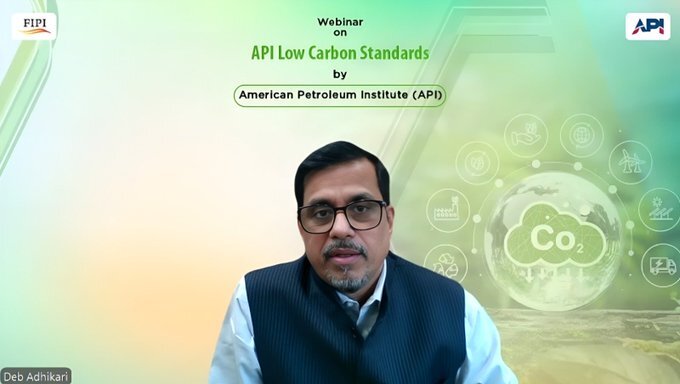
Mr. Deb Adhikari, Director (Exploration & Production), FIPI, welcomed the distinguished speaker from the American Petroleum Institute (API) and all participants who joined virtually for the webinar on "API Low Carbon Standardization."
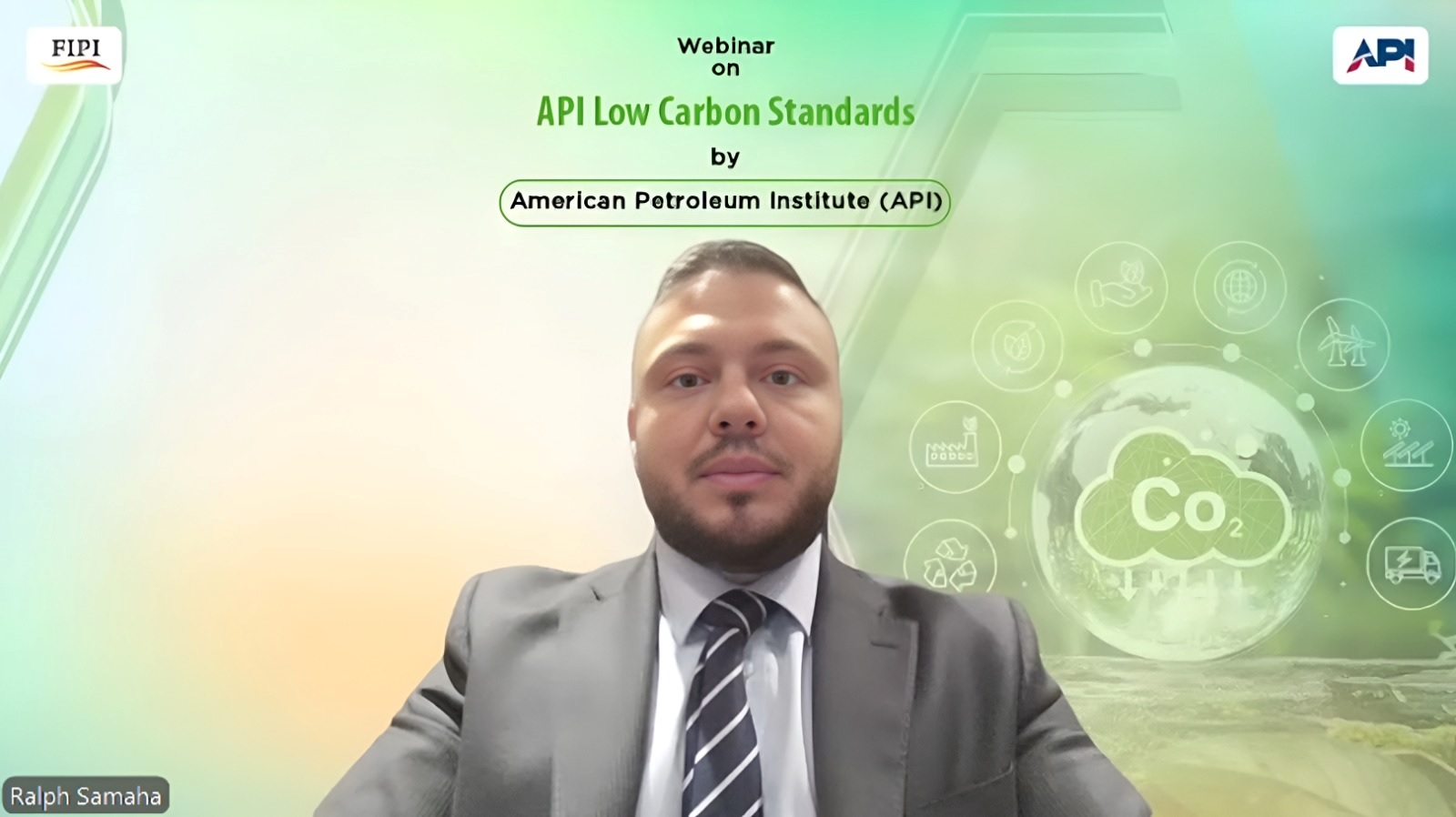
Mr. Ralph Samaha, American Petroleum Institute (API) delivered an insightful presentation, providing participants with a comperhensive overview of API's Low Carbon Standardization.
12-June-2026
Opening Remarks
In his opening remarks, Mr. Deb Adhikari, highlighted that nations, industries and consumers are increasingly seeking meaningful pathways to meet growing energy needs while also addressing the challenge of climate change. He emphasized that achieving this elusive balance requires not only technological innovation and investment, but also robust standards and frameworks that enable consistent measurement, reporting, and verification of emissions and decarbonization efforts. As companies around the world pursue decarbonization he highlighted the critical role of API standards in creating a common language for the entire energy ecosystem, promoting transparency, enhancing credibility, facilitating benchmarking, and supporting informed decision-making.
Mr. Adhikari underscored that the energy transition project presents both opportunities and responsibilities for India. As one of the world’s fastest-growing major economies, India must continue to ensure energy security and affordability while advancing its climate commitments and sustainability objectives. He also stated that the petroleum and natural gas industry will continue to play an important role in the energy mix for the foreseeable future, even as it works towards reducing its carbon footprint through improved efficiency, emissions management, carbon capture technologies, low-carbon fuels, and other innovative solutions.
In this context, Mr. Adhikari described the webinar as an excellent platform to gain insights into the development and implementation of API's low carbon standards directly from subject matter experts. He noted that the session would also be highly valuable for students and the wider academic community, whose research, innovation, and fresh perspectives continue to shape the future of the energy sector.
In closing, he thanked API for partnering with FIPI on this initiative and warmly welcomed the speaker for the session, Mr. Ralph Samaha, Chief Representative – Middle East, Africa, and India, API, along with all the participants.
Presentation on API Low Carbon Standards
Mr. Ralph Samaha began his presentation by highlighting API's offerings in standards development, certification programs, training, auditing, personnel qualification, publications, and a range of other initiatives that help improve safety, quality, and operational performance across the energy value chain.
Mr. Samaha emphasized that standards play a critical role in supporting the scaling and adoption of low carbon technologies by creating consistency, building confidence among investors and operators, supporting international collaboration, and accelerating the deployment of new technologies. He stated that API's low carbon standards initiatives are intended to help the industry deploy emerging technologies with the same level of safety, reliability, and consistency that API standards have historically brought to conventional oil and gas..
Recognizing the growing need for industry alignment around emerging technologies, API's Global Industry Services (GIS) Division established its Low Carbon Standards team vertical. He explained that API undertakes pre-standardization activities, including research and gap analyses, while also updating existing standards to incorporate low-carbon technologies. These efforts are focused on five key areas: Carbon Capture, Utilization and Storage (CCUS), hydrogen, greenhouse gas abatement, life cycle assessment, and renewables—mostly geothermal..
Mr. Samaha He explained that CCUS involves capturing carbon dioxide from industrial facilities or directly from the atmosphere, followed by compression, transportation, utilization and/or permanent storage. He also noted that large-scale CCUS deployment requires clear guidance on transportation infrastructure, materials, well integrity, measurement, monitoring and long-term reliability. API is therefore reviewing existing standards and identifying areas where updates or additional guidance may be required for CO₂ service conditions.
Mr. Samaha further explained that captured CO₂ can be used in several applications, including enhanced oil recovery, building materials, chemical synthesis, fuels and food and beverage products. However, he clarified that utilization alone may not absorb all captured emissions, making long-term geological storage an important pathway. He also highlighted that different carbon capture methods produce CO₂ streams with varying compositions and impurities, which can affect material selection, transportation, storage and system performance. This reinforces the need for common technical frameworks across the CCUS value chain.
On hydrogen, Mr. Samaha stated that while hydrogen is often viewed as a new energy solution, the oil and gas industry has been producing, transporting, storing and using hydrogen for decades, particularly in refining and petrochemical operations. He discussed key production pathways such as steam methane reforming, coal gasification and electrolysis, noting that the carbon intensity of hydrogen depends on the method of production and the source of energy used.
He also highlighted API’s work in updating existing standards to support hydrogen applications. He referred to API Spec 6D, which has been updated to include hydrogen gas service for pipeline valves, and API Spec 5L, which supports line pipe manufacturing and is being expanded for emerging applications such as CO₂ and hydrogen transportation. API is also exploring further work in areas such as hydrogen leak detection, above-ground storage and underground geological storage.
Mr. Samaha also discussed geothermal energy as an area where oil and gas expertise can be effectively applied. He stated that geothermal projects rely significantly on drilling, well design and subsurface knowledge, which are areas where the oil and gas industry has extensive experience. He mentioned that while several existing API standards may already be relevant for geothermal operations, some may require updates to address geothermal-specific operating conditions, including higher temperature environments.
In the context of offshore wind, Mr. Samaha highlighted that API is helping transfer offshore oil and gas experience to the offshore wind sector, especially in areas such as asset integrity, workforce safety, risk management, environmental protection and offshore operations. He referred to API Recommended Practice 75, which provides a Safety and Environmental Management System framework, and API Recommended Practice 75W, which adapts this framework for offshore wind operations. This reflects API’s approach of leveraging proven standards and modifying them to meet the requirements of emerging low-carbon sectors.
In conclusion, Mr. Samaha stated that while technologies such as CCUS, hydrogen, geothermal energy and offshore wind differ in application, they share a common requirement for standards that support safety, reliability, interoperability and scalability. He emphasized that innovation will drive the deployment of low carbon technologies, but standards, operational experience and industry collaboration are essential to enable these technologies to be deployed safely and at scale.
Mr. Samaha then conducted the Q&A session, addressing the various queries raised by participants and sharing his views and insights on the topics discussed. In closing, FIPI complimented the API team for the informative and comprehensive presentation and thanked the participants from the student chapters and the energy industry for their active and engaging participation throughout the event.
Webinar on Consultation paper on “Framework for Leasi..
Global Energy Leadership Dialogue - 'Energy Security Re..
Webinar on Recent Judicial Developments in Internationa..
Webinar on API Low Carbon Standards ..
14th Annual Convention of FIPI Student Chapters ..
Webinar on Oilfield Equipment Leasing- a permissible ac..
Webinar on “LNG at the Crossroads: Fundamentals and P..
Webinar on An overview of API standardization and certi..
FIPI Post Budget Analysis 2026..
FIPI Annual Awards 2024-25- A Glimpse of Winners..