
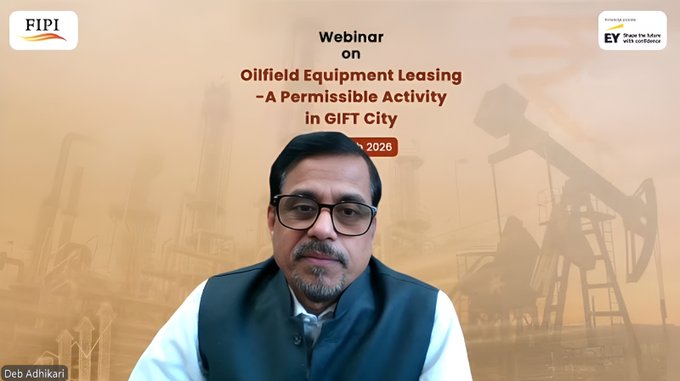
Mr. Deb Adhikari, Director (Exploration & Production), FIPI, in his opening remarks warmly welcomed the eminent speakers from knowledge partner EY, along with all the participants who joined the webinar.
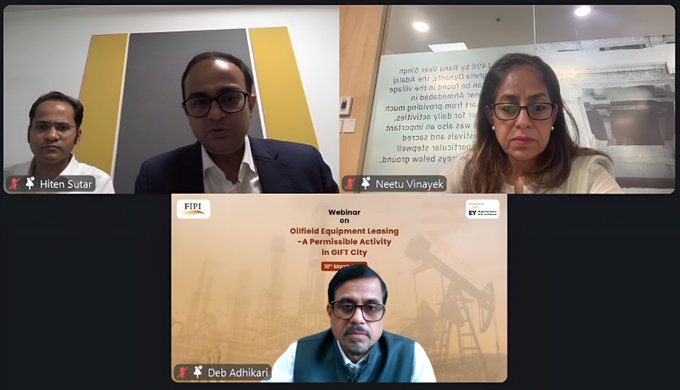
During the webinar, eminent speakers Ms. Neetu Vinayek, Partner, EY and Mr. Hiten Sutar, Partner, Direct Tax, EY India delivered an insightful and comprehensive presentation. They highlighted the nuances of the recently issued notification recognizing operating leases, including hybrid models combining operating and financial leases, with a special focus on oilfield equipment leasing and the associated tax incentives available in GIFT City.
18-March-2026
Mr. Deb Adhikari, Director (E&P), FIPI began the session with the opening remarks. He mentioned that as India is heavily dependent on crude oil imports, accounting for approximately 87% of its crude oil consumption, the country relies on imported oilfield equipment for its domestic oil and gas production needs. The outright purchasing of such equipment can be capital-intensive. Leasing offers an efficient solution, enabling companies to access high-quality equipment without upfront costs, thereby improving cash flow and operational flexibility. He mentioned that Indian companies on an average are investing approximately USD 3-5 bn of their budget for E&P activities and about 60% is spent for importing the costly equipment and technologies.
He further said that oilfield equipment leasing, a newly enabled and permitted financial activity in GIFT city, regulated by the International Financial Services Centers Authority (IFSCA) allows entities to lease high-value assets such as rigs, offshore vessels, wellhead equipment’s, compressors, and specialized service units to Indian operators, supporting the energy sector by facilitating cost-effective access to cutting-edge oilfield equipment through leasing arrangements. He said that globally, many developed economies like the European countries and U.S. as well as some Asian countries like Malaysia, have successfully adopted leasing models to optimize costs, enhance efficiency, and gain access to the latest technological advancements.
Ms. Neetu Vinayek, Partner, EY said that with the current situation, energy markets are navigating through intense geopolitical volatility, driving a strong focus on energy independence, and increased exploration and production (E&P) to secure economic growth. She said that the global oilfield equipment market is estimated to be valued at USD 249 billion in 2026 and is projected to reach USD 282 billion by 2031. Based on the size of the market, it is estimated that the Asia-Pacific oilfield equipment market is experiencing significant growth, driven by surging energy demand in India and China, with the oilfield equipment rental sector emerging as a preferred, cost-effective model. Thus, to address the high energy demand and growing oil exploration activities in India and the wider Asia-Pacific region, the International Financial Services Centers Authority (IFSCA) has officially expanded its leasing framework within GIFT City (Gujarat International Finance Tec-City) to include oil field equipment, with the regulation coming into effect in January 2026. The transformation of GIFT City into a major global financial hub can be seen from the entities that are surging from approximately 129 to over 1100 by the end of 2025.
She then mentioned that under IFSC, the ecosystem comprises of a robust mix of financial institutions acting as a gateway for international capital. It includes- Banking Units, International Exchanges, Funds & Asset Management, Insurance Companies & Intermediaries. Under the permissible activities, she mentioned that leasing and financing are firmly established for aircraft and ships, and Oil Field Equipment has been adding as a notification in January 2026.
Mr. Hiten Sutar, Partner EY said that the International Financial Services Centre (IFSC) in India, particularly at GIFT City, is designed as a specialized, tax-neutral zone that acts as a global financial hub, physically located in India but operating under international regulatory frameworks. With the industry facing high capital-intensive demands, enabling oilfield equipment leasing has been a critical focus to reduce upfront cash flows and offer alternative financing models to the oil and gas industry. He said that the IFSCA issued this notification that formally recognises the operating lease, including any hybrid of operating and financial lease, in respect of oilfield equipment as a financial product. Further he said that under the notification, the equipment should be in the table provided in notification number 3 of 2017 of Central Tax (Rate), of 2017. He said that the framework would provide specific rules for operational, financial, and personnel requirements for entities setting up in the IFSC.
He then discussed the comprehensive list, as per Notification No. 3/2017, which covers essential items for upstream, midstream, and downstream operations, including- Survey & Exploration (Land/marine seismic equipment, vessels, and ROVs), Drilling & Production (Rigs, pipes, and wellhead equipment), Support & Logistics: Helicopters, marine support vessels, and diving equipment, Safety & Infrastructure: Fire-fighting systems, cathodic protection, and storage tanks, etc.
He then mentioned the steps to be taken in future such as draft framework will be published, public comments will be invited, submission for comments from stakeholders, and then, the final framework will be issued. Further, he mentioned the example of a ship leasing framework, to explain a typical framework under IFSCA in GIFT City. The permitted legal forms of presence for conducting ship leasing business includes Company¸ Limited Liability Partnership (LLP), Branch, and a Trust. Also, the applicant shall be located in Financial Action task Force (FATF) complaint jurisdiction, and Minimum Owned Funds requirement is around $200,000 for operating lease and $3 million for financial lease. Also, there is a requirement of maintenance of books of accounts, records, and documents, and, those should be in freely convertible foreign currency. Further, they should also furnish the annual auditor financial statement confirmation compliance with the IFSCA regulatory authority.
He said that the typical timeline for setting up an entity in GIFT city is generally 3-4 months, subject to meeting all the requirements of the framework, and the documentation should be in place. He also said that within 6 months from the date of registration, the certificate of commencement should be obtained with respect to activities which are there in GIFT city. In terms of approvals, IFSCA registration, SEZ license, PAN & TAN registration, GST & custom registration are required.
He then talked about the taxation aspects which are typically applicable to GIFT City. He said that the government has agreed that there should be a tax holiday of 20 years out of first 25 years of operation and in the years where the tax holiday is not taken by the GIFT city undertaking, the tax rate should be 15%. Further, the IFSC units have to pay Minimum Alternate tax at 9%, especially applicable to structures such as LLP. Further, he mentioned about the additional benefits which are available to the non-resident for ships and aircraft includes, viz, exemption for royalty income, dividends to non-resident taxable at 10% and capital gains on transfer of shares by non-resident exempt from tax. The indirect tax benefits include- the import of goods, is exempt from basic custom duty. Further no IGST on value of goods imported for authorized operations by IFSC company.
Lastly, he concluded by saying that an entity needs a thorough analysis of existing business model to evaluate the new business model in IFSC; then examine the framework that is to be issued for Oilfield equipment leasing and evaluate the optimum structure for leasing of oilfield equipment that can be adopted in IFSC.
Ms. Neetu Vinayek and Mr. Hiten Sutar, then conducted the Q&A session and provided their views and opinions on various queries posted by participants.
Lastly, FIPI complimented the EY team for an elaborative presentation on the Oilfield Equipment leasing. FIPI also thanked the participants from the energy industry for their active and interactive participation during the event.
Webinar on Consultation paper on “Framework for Leasi..
Global Energy Leadership Dialogue - 'Energy Security Re..
Webinar on Recent Judicial Developments in Internationa..
Webinar on API Low Carbon Standards ..
14th Annual Convention of FIPI Student Chapters ..
Webinar on Oilfield Equipment Leasing- a permissible ac..
Webinar on “LNG at the Crossroads: Fundamentals and P..
Webinar on An overview of API standardization and certi..
FIPI Post Budget Analysis 2026..
FIPI Annual Awards 2024-25- A Glimpse of Winners..