
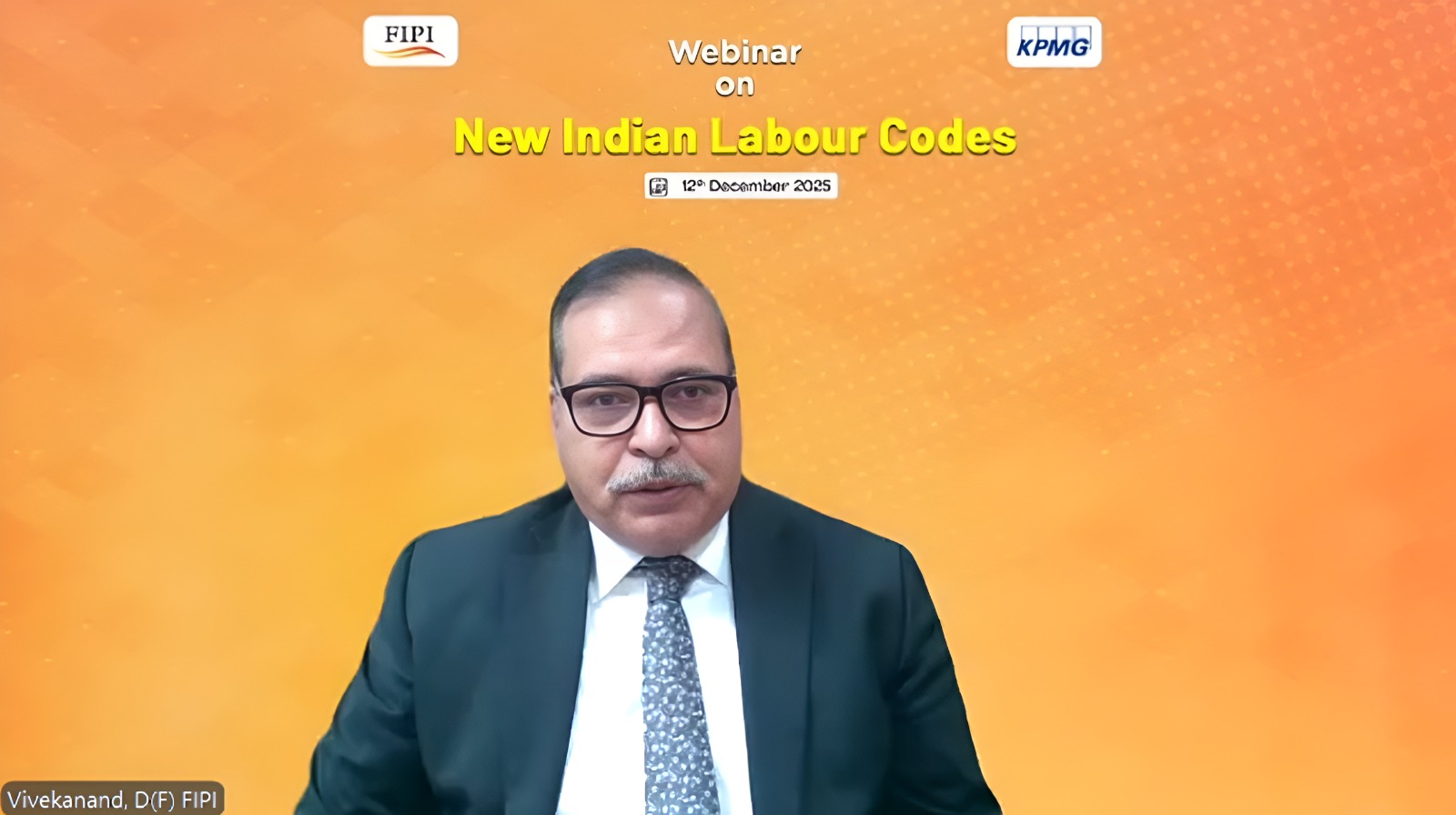
Shri Vivekanand, Director (Finance, Taxations & Legal), FIPI, in his opening remarks, extended a warm welcome to the eminent speakers from KPMG India and all participants who joined the webinar on “New Indian Labour Codes”.
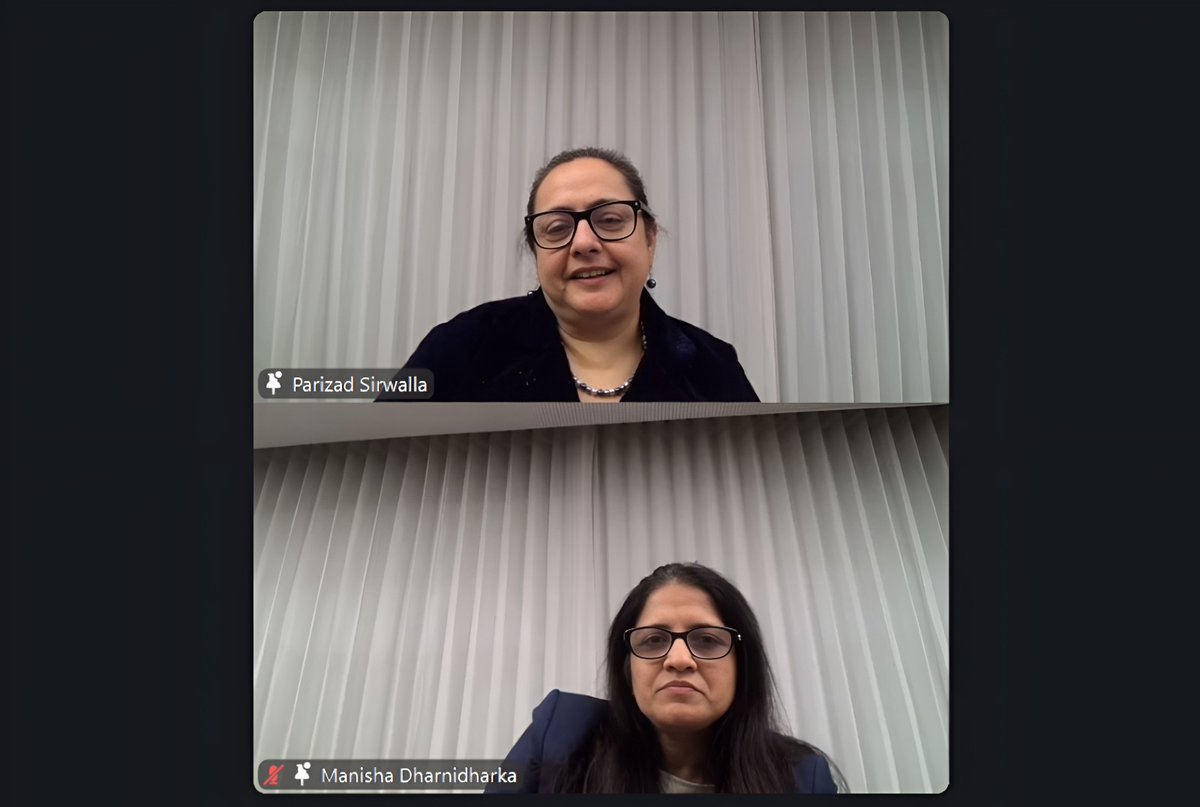
Ms. Parizad Sirwalla, Partner & National Head, Global Mobility Services, Tax at KPMG India and Ms. Manisha Dharnidharka, Chartered Accountant delivered an insightful and engaging session
12-December-2025
Mr. Vivekanand, Director (Finance, Taxation & Legal), FIPI began the session with the opening remarks. He said that India's economy is growing currently at a robust rate of 6.5 per cent, driven by the strong performance of the services, manufacturing, and construction sectors, that positions India as the fastest-growing large economy globally. He mentioned about the report from India's Ministry of Labor and Employment stating significant job growth, with employment reaching 64 crores in 2023-24, adding nearly 17 crore jobs over six years and projected that another 7 crores will be added in the next six years. He also cited the recent report from Manpower Group that talked about India's strong job market, with a high Net Employment Outlook (NEO) of 52 per cent for 2026, second only to Brazil, signaling significant employer confidence in hiring. In this regard, he welcomed the recent labour reforms that has amalgamated Labour Codes into four categories namely - Wages, Social Security, Industrial Relations and Occupational Safety, Health & Working Conditions, replacing the 29 obsolete labor laws with a uniform, modern regulatory environment. Therefore, it is expected that these labor reforms will have a positive impact on key Indian government initiatives like Viksit Bharat and Make in India and would foster economic growth, development, and self-reliance.
Ms. Parizad Sirwalla, Partner and National Head, Global Mobility Services, Tax – KPMG in India said that India's four new Labour Codes became effective nationwide on 21 November 2025, with the stated objective of transforming workplace culture, enhancing transparency and strengthening social security for all workers. She said that the codes aim to strengthen women's participation and equality in the workforce through several provisions and ensure minimum standards for health and safety. She then highlighted that the process of consolidating numerous existing laws into four comprehensive Labour Codes was a multi-year effort that began well before they were finally passed. The Code on Wages was enacted in 2019 and the rest three were enacted in 2020, but since labour is a concurrent subject in India's Constitution, extensive consultations with states and other stakeholders for each of these codes was required before it could be finally notified.
She discussed the first Code on Wages which stated that its prime objective was to streamline all the wage-related regulations and ensure uniformity across different types of employment. The Code talked about the the Equal Remuneration Act 1976, which aimed at preventing gender discrimination in wage payments; the Payment of Bonus Act, which governed bonus payments based on profits and productivity ; the Minimum Wage Act of 1948, which enabled ensured minimum wage standards for scheduled employments and lastly the Payment of Wages Act 1936, which regulated timely payment of wages and prevented undue deductions. She mentioned that the key change was that the wage code would cover all employees and employers, irrespective of the wage ceiling and the sector. Another key change was the concept of flow wages for workers, which stated that a national floor wage will be fixed by the Central Government and this mandates the state to fix minimum wage for all employees equal to or above the floor wage. In addition, in relation to payment of wages after retrenchment or resignation, the same would need to be done within two working days. The code also brought about a provision for appointment of an inspector cum facilitator to carry out inspections and provide information to employers and employees for better compliance. She said that this move led to shifting the enforcement towards a guidance mechanism and a compliance support to organisations.
She then highlighted that the new labour laws brought a welcome change by introducing a single, uniform and consistent definition of ‘wages’ across all related legislation which acts as a universal base for calculating all statutory contributions and benefits. She said that the new definition may thus lead to higher contributions and payouts in social security schemes for both employees and employers, depending on an individual's current compensation structure.
Ms. Manisha Dharnidharka, Chartered Accountant, then talked about the key change in the labour law as recognition of the new category of workers namely- gig workers, platform workers, home-based workers, fixed-term employees, unorganised workers; which have now been well defined under the law. This is done to keep pace with the changing business dynamics, especially post-COVID and to provide the government a base to be able to extend Social Security benefits to them. Further, she talked about other changes such as- women employees allowed to work from home post maternity leave by mutual agreement; employee centers to be replaced with career centers; usage of AADHAR in actual enforcement of Social Security schemes; for fixed-term employees, gratuity will be given to them on a pro-rata basis after completing one year of service; for unorganised workers, welfare schemes covering social security, injury, housing, education, etc. will be notified.
For the next code on Occupational Safety and Health Code (OSH), Ms. Manisha talked about the difference between a worker and an employee. She said that a worker is a subset of an employee and includes only non-managerial or non-administrative or non-supervisory staff (earning wages below the specified threshold of 15000/18000 per month as the case may be) . Since certain provisions are applicable only to workers, the employers thus need to identify carefully whether they classify him as a worker or an employee. Further, she said that the contract labour cannot be employed in core activities of the organisation with few exceptions such as contract labor can be employed if the normal functioning of the establishment is such that it is ordinarily done through a contractor, activities do not require full time workers, to cater to any sudden increase of volume of work, in services such as sanitation, security, canteen, housekeeping, courier, transport etc. Also, under OSH Code, principal employer remains liable for the health and safety benefits etc. of the contract labour. She then highlighted key changes under OSH Code- for instance- the workers can carry forward up to only 30 days of unavailed leave; provision of creche facilities with establishments wherein 50 or more workers/employees are engaged; free annual health checkup for specified employees; a safety committee is mandated for establishments with specified thresholds of workers; issuance of appointment letters has been made mandatory. Many provisions driving inclusivity include- that women are allowed to work now before 6.00a.m. and after 7.00p.m., after due consent and subject to safety measures. Further protective equipment like safety gear needs to be obtained wherever women are employed in hazardous processes, including appropriate facilities.
Moving on to the last code, which is the Industrial Relations Code, Ms. Manisha said that the key change here includes introducing a concept of negotiating Union or Council for an establishment having multiple registered trade unions. Also, Industrial Tribunals are to be constituted in place of court of inquiry, Board of Conciliation, and labour courts. Further the new Code has increased the threshold of workers to 300 for obtaining the consent of government in case of layoff, retrenchment, etc. In Industrial Relations Code, Industrial Establishments employing 20 or more workers are now required to form grievance redressal committee to investigate grievances. It needs to have an equal representation of workers and employees.
Lastly, Ms Parizad concluded by saying that every organisation needs to evaluate the impact of these new Labour Codes vis-a-vis on their compensation structure, the HR policy, the contractor arrangements, and various compliance and statutory frameworks. They will need to evaluate the financial implications in detail, relook at the payroll and compliances based on the new definition of wages, modify the existing vendor and contractor arrangements considering principal employer provisions, and relook at the health, safety work policies. She said that the codes are thus designed to create a balanced relationship between the employees and the employers, to encourage collaborative agreements and foster a productive work environment.
Ms. Parizad and Ms. Manisha, then conducted the Q&A session and provided their views and opinions on various queries posted by participants.
Lastly, FIPI complimented the speakers for an elaborative presentation on the topic covering provisions and their implications and highlighting the key norms in the Labour Code. FIPI also thanked the participants from the energy industry for their active and interactive participation during the event. The webinar was very well attended and was immensely appreciated for its content and clarity.

Webinar on Consultation paper on “Framework for Leasi..

Global Energy Leadership Dialogue - 'Energy Security Re..
Webinar on Recent Judicial Developments in Internationa..
Webinar on API Low Carbon Standards ..
14th Annual Convention of FIPI Student Chapters ..

Webinar on Oilfield Equipment Leasing- a permissible ac..

Webinar on “LNG at the Crossroads: Fundamentals and P..

Webinar on An overview of API standardization and certi..
FIPI Post Budget Analysis 2026..

FIPI Annual Awards 2024-25- A Glimpse of Winners..