


Page 32 - Policy Economic Report - March 2026
P. 32
POLICY AND ECONOMIC REPORT
            OIL & GAS MARKET

            Oil demand situation

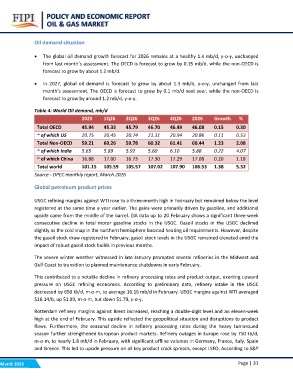
            ? The global oil demand growth forecast for 2026 remains at a healthy 1.4 mb/d, y-o-y, unchanged
                from last month’s assessment. The OECD is forecast to grow by 0.15 mb/d, while the non-OECD is
                forecast to grow by about 1.2 mb/d.

            ? In 2027, global oil demand is forecast to grow by about 1.3 mb/d, y-o-y, unchanged from last
                month’s assessment. The OECD is forecast to grow by 0.1 mb/d next year, while the non-OECD is
                forecast to grow by around 1.2 mb/d, y-o-y.

            Table 4: World Oil demand, mb/d           2Q26   3Q26    4Q26    2026    Growth %
                                       2025 1Q26             46.70   46.49   46.08   0.15 0.30
                                                             21.31   20.94   20.86   0.11 0.53
            Total OECD      45.94 45.33 45.79                60.32   61.41   60.44   1.23 2.08
                                                             5.60    6.10    5.88    0.22 4.07
            ~ of which US   20.75  20.45              20.74  17.30   17.29   17.08   0.20 1.18
            Total Non-OECD  59.21  60.26              59.78  107.02  107.90  106.53  1.38 5.32

            ~ of which India 5.65 5.89 5.92

            ~ of which China 16.88 17.00 16.73

            Total world     101.15 105.59 105.57

            Source - OPEC monthly report, March 2026

            Global petroleum product prices

            USGC refining margins against WTI rose to a three-month high in February but remained below the level
            registered at the same time a year earlier. The gains were primarily driven by gasoline, and additional
            upside came from the middle of the barrel. EIA data up to 20 February shows a significant three-week
            consecutive decline in total motor gasoline stocks in the USGC. Gasoil stocks in the USGC declined
            slightly as the cold snap in the northern hemisphere boosted heating oil requirements. However, despite
            the gasoil stock draw registered in February, gasoil stock levels in the USGC remained elevated amid the
            impact of robust gasoil stock builds in previous months.

            The severe winter weather witnessed in late January prompted several refineries in the Midwest and
            Gulf Coast to transition to planned maintenance shutdowns in early February.

            This contributed to a notable decline in refinery processing rates and product output, exerting upward
            pressure on USGC refining economics. According to preliminary data, refinery intake in the USGC
            decreased by 650 tb/d, m-o-m, to average 16.16 mb/d in February. USGC margins against WTI averaged
            $16.14/b, up $1.99, m-o-m, but down $1.79, y-o-y.

            Rotterdam refinery margins against Brent increased, reaching a double-digit level and an eleven-week
            high at the end of February. This upside reflected the geopolitical situation and disruptions to product
            flows. Furthermore, the seasonal decline in refinery processing rates during the heavy turnaround
            season further strengthened European product markets. Refinery outages in Europe rose by 750 tb/d,
            m-o-m, to nearly 1.8 mb/d in February, with significant offline volumes in Germany, France, Italy, Spain
            and Greece. This led to upside pressure on all key product crack spreads, except LSFO. According to S&P

March 2026                                                                           Page | 31

