


Page 14 - Policy Economic Report- June'26
P. 14
POLICY AND ECONOMIC REPORT
               OIL & GAS MARKET

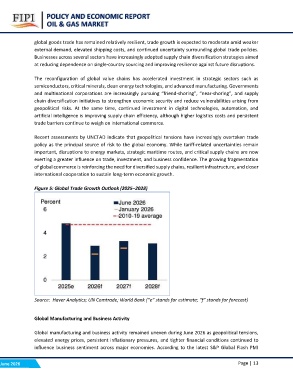
           global goods trade has remained relatively resilient, trade growth is expected to moderate amid weaker
           external demand, elevated shipping costs, and continued uncertainty surrounding global trade policies.
           Businesses across several sectors have increasingly adopted supply chain diversification strategies aimed
           at reducing dependence on single-country sourcing and improving resilience against future disruptions.

           The reconfiguration of global value chains has accelerated investment in strategic sectors such as
           semiconductors, critical minerals, clean energy technologies, and advanced manufacturing. Governments
           and multinational corporations are increasingly pursuing “friend-shoring”, “near-shoring”, and supply
           chain diversification initiatives to strengthen economic security and reduce vulnerabilities arising from
           geopolitical risks. At the same time, continued investment in digital technologies, automation, and
           artificial intelligence is improving supply chain efficiency, although higher logistics costs and persistent
           trade barriers continue to weigh on international commerce.

           Recent assessments by UNCTAD indicate that geopolitical tensions have increasingly overtaken trade
           policy as the principal source of risk to the global economy. While tariff-related uncertainties remain
           important, disruptions to energy markets, strategic maritime routes, and critical supply chains are now
           exerting a greater influence on trade, investment, and business confidence. The growing fragmentation
           of global commerce is reinforcing the need for diversified supply chains, resilient infrastructure, and closer
           international cooperation to sustain long-term economic growth.

           Figure 5: Global Trade Growth Outlook (2025–2028)

           Source: Haver Analytics; UN Comtrade; World Bank (“e” stands for estimate; “f” stands for forecast)

June 2026  Global Manufacturing and Business Activity

           Global manufacturing and business activity remained uneven during June 2026 as geopolitical tensions,
           elevated energy prices, persistent inflationary pressures, and tighter financial conditions continued to
           influence business sentiment across major economies. According to the latest S&P Global Flash PMI

                                                                                                                               Page | 13

