


Page 13 - Policy Economic Report - March 2026
P. 13
POLICY AND ECONOMIC REPORT
    OIL & GAS MARKET

outlook in India, however, is generally favourable, supported by record sowings encouraged by
government incentives. Prospects are also positive for Pakistan and broadly favourable in China.

The FAO brief also revised upwards its estimate for 2025 global cereal production to a record 3 029
million tonnes, a 5.6 percent increase from the previous year. The forecast for world cereal utilization in
2025-26 has also been revised upwards, to a record 2 943 million tonnes, with gains expected for wheat,
coarse grains, and rice. The new estimates point to world cereal stocks likely rising to 940.5 million
tonnes by the close of seasons, resulting in a comfortable global cereals stocks-to-use ratio of 31.9
percent.

FAO estimates that 41 countries globally, most of them in Africa, require external assistance for food,
due mostly to conflict and insecurity and in some cases to weather-related shocks, according to a
separate report also released today by FAO’s Global Information and Early Warning System (GIEWS).
Among the 44 Low-Income Food Deficit Countries, aggregate cereal output is expected to decline by 1.0
percent in the 2025-26 season, while utilization is likely to grow by 1.5 percent, pushing up import needs
marginally year-on-year to 55.7 million tonnes.

4. Project Facilitation: The way to enhance Sustainable Aviation Fuel projects bankability
Aviation and freight play a vital role in the global transport sector, connecting people and moving traded
goods from and to different places in the world. The sector accounts for around 2% to 3% of global
carbon dioxide emissions, according to the International Civil Aviation Organization’s (ICAO) overview on
aviation and climate change, and emissions could rise further as air traffic continues to grow.

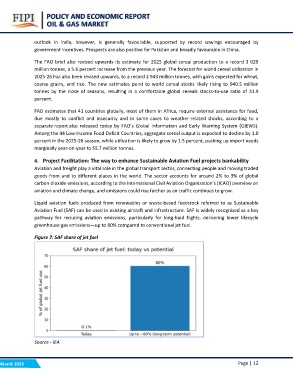
Liquid aviation fuels produced from renewables or waste-based feedstock referred to as Sustainable
Aviation Fuel (SAF) can be used in existing aircraft and infrastructure. SAF is widely recognized as a key
pathway for reducing aviation emissions, particularly for long-haul flights, delivering lower lifecycle
greenhouse gas emissions—up to 80% compared to conventional jet fuel.

Figure 7: SAF share of jet fuel

                   Source - IEA  Page | 12

March 2026

