


Page 12 - Policy Economic Report - March 2026
P. 12
POLICY AND ECONOMIC REPORT
                OIL & GAS MARKET

            3. FAO Food Price Index rises in February for first time in five months
            The benchmark measure for world food commodity prices rose in February, ending a five-month
            downward trend, as higher quotations for wheat, most vegetable oils and several meat types
            outweighed declines in cheese and sugar prices, according to the new update released today by the
            Food and Agriculture Organization of the United Nations (FAO).

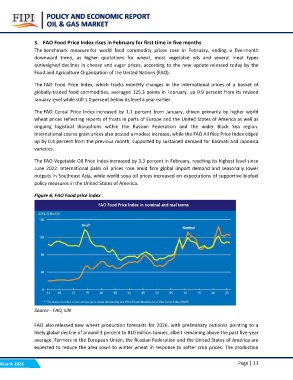
            The FAO Food Price Index, which tracks monthly changes in the international prices of a basket of
            globally-traded food commodities, averaged 125.3 points in February, up 0.9 percent from its revised
            January level while still 1.0 percent below its level a year earlier.

            The FAO Cereal Price Index increased by 1.1 percent from January, driven primarily by higher world
            wheat prices reflecting reports of frosts in parts of Europe and the United States of America as well as
            ongoing logistical disruptions within the Russian Federation and the wider Black Sea region.
            International coarse grain prices also posted a modest increase, while the FAO All Rice Price Index edged
            up by 0.4 percent from the previous month, supported by sustained demand for basmati and Japonica
            varieties.

            The FAO Vegetable Oil Price Index increased by 3.3 percent in February, reaching its highest level since
            June 2022. International palm oil prices rose amid firm global import demand and seasonally lower
            outputs in Southeast Asia, while world soya oil prices increased on expectations of supportive biofuel
            policy measures in the United States of America.

            Figure 6: FAO Food price index

            Source - FAO, UN

            FAO also released new wheat production forecasts for 2026, with preliminary outlooks pointing to a
            likely global decline of around 3 percent to 810 million tonnes, albeit remaining above the past five-year
            average. Farmers in the European Union, the Russian Federation and the United States of America are
            expected to reduce the area sown to winter wheat in response to softer crop prices. The production

March 2026                    Page | 11

