


Page 40 - Policy Economic Report- June'26
P. 40
POLICY AND ECONOMIC REPORT
           OIL & GAS MARKET

           Oil demand situation

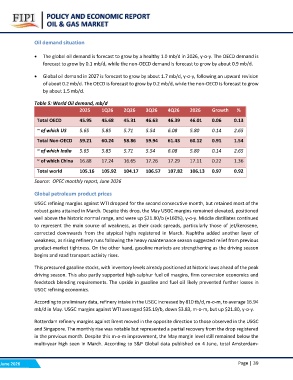
           • The global oil demand is forecast to grow by a healthy 1.0 mb/d in 2026, y-o-y. The OECD demand is
               forecast to grow by 0.1 mb/d, while the non-OECD demand is forecast to grow by about 0.9 mb/d.

           • Global oil demand in 2027 is forecast to grow by about 1.7 mb/d, y-o-y, following an upward revision
               of about 0.2 mb/d. The OECD is forecast to grow by 0.2 mb/d, while the non-OECD is forecast to grow
               by about 1.5 mb/d.

           Table 5: World Oil demand, mb/d         2Q26  3Q26    4Q26    2026    Growth %
                                    2025 1Q26            46.63   46.39   46.01   0.06 0.13
                                                         5.54    6.08    5.80    0.14 2.65
           Total OECD   45.95 45.68 45.31                59.94   61.43   60.12   0.91 1.54
                                                         5.54    6.08    5.80    0.14 2.65
           ~ of which US 5.65 5.85 5.71                  17.26   17.29   17.11   0.22 1.36
                                                         106.57  107.82  106.13  0.97 0.92
           Total Non-OECD 59.21 60.24 58.86

           ~ of which India 5.65 5.85 5.71

           ~ of which China 16.88 17.24 16.65

           Total world  105.16 105.92 104.17

           Source: OPEC monthly report, June 2026

           Global petroleum product prices

           USGC refining margins against WTI dropped for the second consecutive month, but retained most of the
           robust gains attained in March. Despite this drop, the May USGC margins remained elevated, positioned
           well above the historic normal range, and were up $21.80/b (+160%), y-o-y. Middle distillates continued
           to represent the main source of weakness, as their crack spreads, particularly those of jet/kerosene,
           corrected downwards from the atypical highs registered in March. Naphtha added another layer of
           weakness, as rising refinery runs following the heavy maintenance season suggested relief from previous
           product-market tightness. On the other hand, gasoline markets are strengthening as the driving season
           begins and road transport activity rises.

           This pressured gasoline stocks, with inventory levels already positioned at historic lows ahead of the peak
           driving season. This also partly supported high-sulphur fuel oil margins, firm conversion economics and
           feedstock blending requirements. The upside in gasoline and fuel oil likely prevented further losses in
           USGC refining economics.

           According to preliminary data, refinery intake in the USGC increased by 810 tb/d, m-o-m, to average 16.94
           mb/d in May. USGC margins against WTI averaged $35.19/b, down $3.83, m-o-m, but up $21.80, y-o-y.

           Rotterdam refinery margins against Brent moved in the opposite direction to those observed in the USGC
           and Singapore. The monthly rise was notable but represented a partial recovery from the drop registered
           in the previous month. Despite this m-o-m improvement, the May margin level still remained below the
           multi-year high seen in March. According to S&P Global data published on 4 June, total Amsterdam-

June 2026                                                                        Page | 39

