


Page 30 - Policy Economic Report - Feb 2026
P. 30
POLICY AND ECONOMIC REPORT
               OIL & GAS MARKET

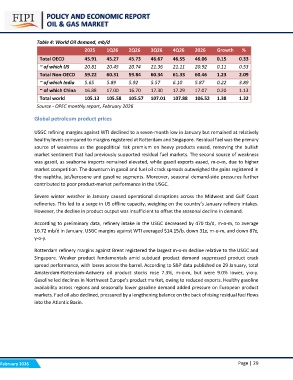
               Table 4: World Oil demand, mb/d

                                 2025 1Q26 2Q26             3Q26    4Q26    2026    Growth %
                                                            46.67   46.55   46.06   0.15 0.33
               Total OECD        45.91 45.27 45.73          21.36   21.11   20.92   0.11 0.53
                                                            60.34   61.33   60.46   1.23 2.09
               ~ of which US     20.81 20.45 20.74          5.57    6.10    5.87    0.22 3.89
                                                            17.30   17.29   17.07   0.20 1.13
               Total Non-OECD    59.22  60.31   59.84       107.01  107.88  106.52  1.38 1.32
               ~ of which India  5.65   5.89    5.92
               ~ of which China  16.88  17.00   16.70

               Total world       105.13 105.58 105.57

               Source - OPEC monthly report, February 2026

               Global petroleum product prices

               USGC refining margins against WTI declined to a seven-month low in January but remained at relatively
               healthy levels compared to margins registered at Rotterdam and Singapore. Residual fuel was the primary
               source of weakness as the geopolitical risk premium on heavy products eased, removing the bullish
               market sentiment that had previously supported residual fuel markets. The second source of weakness
               was gasoil, as seaborne imports remained elevated, while gasoil exports eased, m-o-m, due to higher
               market competition. The downturn in gasoil and fuel oil crack spreads outweighed the gains registered in
               the naphtha, jet/kerosene and gasoline segments. Moreover, seasonal demand-side pressures further
               contributed to poor product-market performance in the USGC.

               Severe winter weather in January caused operational disruptions across the Midwest and Gulf Coast
               refineries. This led to a surge in US offline capacity, weighing on the country’s January refinery intakes.
               However, the decline in product output was insufficient to offset the seasonal decline in demand.

               According to preliminary data, refinery intake in the USGC decreased by 470 tb/d, m-o-m, to average
               16.72 mb/d in January. USGC margins against WTI averaged $14.15/b, down 31?, m-o-m, and down 87?,
               y-o-y.

               Rotterdam refinery margins against Brent registered the largest m-o-m decline relative to the USGC and
               Singapore. Weaker product fundamentals amid subdued product demand suppressed product crack
               spread performance, with losses across the barrel. According to S&P data published on 29 January, total
               Amsterdam-Rotterdam-Antwerp oil product stocks rose 7.3%, m-o-m, but were 9.0% lower, y-o-y.
               Gasoline led declines in Northwest Europe’s product market, owing to reduced exports. Healthy gasoline
               availability across regions and seasonally lower gasoline demand added pressure on European product
               markets. Fuel oil also declined, pressured by a lengthening balance on the back of rising residual fuel flows
               into the Atlantic Basin.

February 2026                                                                       Page | 29

