


Page 10 - Policy Economic Report - Feb 2026
P. 10
POLICY AND ECONOMIC REPORT
    OIL & GAS MARKET

New skills, new tasks, and entirely new occupations are being created alongside automation, offering
alternative pathways for prosperity. For workers, finding or keeping a job will increasingly depend on the
ability to update skills or learn new ones. IMF’s latest analysis of millions of online vacancies reveals the
scale of the demand for new skills: one in 10 job postings in advanced economies and one in 20 in
emerging market economies now require at least one new skill.

Professional, technical, and managerial roles are seeing the most demand for new skills, particularly in IT,
which accounts for more than half of this demand. Sector-specific capabilities are also trending.
Healthcare, for instance, is seeing a surge in telecare and digital health skills, while marketing increasingly
demands expertise in social media.

With nearly 40 percent of global jobs exposed to AI-driven change, concerns about job displacement and
declining opportunities for some groups are becoming more acute. This underscores the need for
proactive and comprehensive policymaking that prepares the labor force for the future of work and
ensures the gains from AI are broadly shared.

Higher Wages, Mixed Job Effects

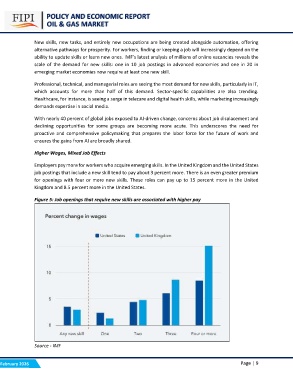
Employers pay more for workers who acquire emerging skills. In the United Kingdom and the United States
job postings that include a new skill tend to pay about 3 percent more. There is an even greater premium
for openings with four or more new skills. These roles can pay up to 15 percent more in the United
Kingdom and 8.5 percent more in the United States.

Figure 5: Job openings that require new skills are associated with higher pay

                   Source - IMF  Page | 9

February 2026

