


Page 30 - Policy Economic Report - November 2025
P. 30
POLICY AND ECONOMIC REPORT
               OIL & GAS MARKET

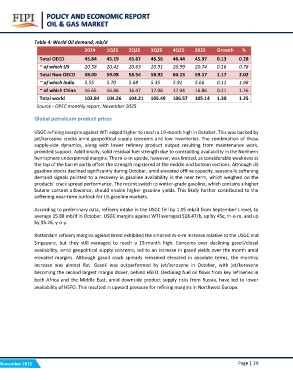
               Table 4: World Oil demand, mb/d

                                 2024 1Q25 2Q25             3Q25    4Q25    2025    Growth %
                                                            46.56   46.44   45.97   0.13 0.28
               Total OECD        45.84 45.19 45.67          20.91   20.99   20.74   0.16 0.78
                                                            58.92   60.13   59.17   1.17 2.02
               ~ of which US     20.58 20.42 20.63          5.35    5.91    5.66    0.11 1.98
                                                            17.06   17.04   16.86   0.21 1.26
               Total Non-OECD    58.00  59.08   58.54       105.49  106.57  105.14  1.30 1.25
               ~ of which India  5.55   5.70    5.68
               ~ of which China  16.65  16.86   16.47

               Total world       103.84 104.26 104.21

               Source - OPEC monthly report, November 2025

               Global petroleum product prices

               USGC refining margins against WTI edged higher to reach a 19-month high in October. This was backed by
               jet/kerosene cracks amid geopolitical supply concerns and low inventories. The combination of these
               supply-side dynamics, along with lower refinery product output resulting from maintenance work,
               provided support. Additionally, solid residual fuel strength due to contracting availability in the Northern
               hemisphere underpinned margins. The m-o-m upside, however, was limited, as considerable weakness at
               the top of the barrel partly offset the strength registered at the middle and bottom sections. Although US
               gasoline stocks declined significantly during October, amid elevated offline capacity, seasonally softening
               demand signals pointed to a recovery in gasoline availability in the near term, which weighed on the
               products' crack spread performance. The recent switch to winter-grade gasoline, which contains a higher
               butane content allowance, should enable higher gasoline yields. This likely further contributed to the
               softening near-term outlook for US gasoline markets.

               According to preliminary data, refinery intake in the USGC fell by 1.05 mb/d from September’s level, to
               average 15.88 mb/d in October. USGC margins against WTI averaged $18.47/b, up by 45?, m-o-m, and up
               by $5.26, y-o-y.

               Rotterdam refinery margins against Brent exhibited the smallest m-o-m increase relative to the USGC and
               Singapore, but they still managed to reach a 19-month high. Concerns over declining gasoil/diesel
               availability, amid geopolitical supply concerns, led to an increase in gasoil yields over the month amid
               elevated margins. Although gasoil crack spreads remained elevated in absolute terms, the monthly
               increase was almost flat. Gasoil was outperformed by jet/kerosene in October, with jet/kerosene
               becoming the second largest margin driver, behind HSFO. Declining fuel oil flows from key refineries in
               both Africa and the Middle East, amid downside product supply risks from Russia, have led to lower
               availability of HSFO. This resulted in upward pressure for refining margins in Northwest Europe.

November 2025                                                                       Page | 29

