


Page 12 - Policy Economic Report - November 2025
P. 12
POLICY AND ECONOMIC REPORT
                   OIL & GAS MARKET

               However, achieving large gains will hinge on European countries’ commitment to growth-enhancing
               reforms and willingness to being flexible on regulation, to help the new technology to flourish. Absent
               reforms, shows that the medium-term gain in productivity from the AI alone would vary considerably
               across countries, and for Europe as a whole would be rather modest: about 1.1 percent cumulatively over
               five years. With pro-growth reforms, though, much bigger gains are possible over the longer run.

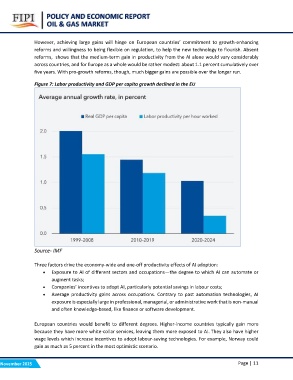
               Figure 7: Labor productivity and GDP per capita growth declined in the EU

               Source- IMF

               Three factors drive the economy-wide and one-off productivity effects of AI adoption:
                   • Exposure to AI of different sectors and occupations—the degree to which AI can automate or
                        augment tasks;
                   • Companies’ incentives to adopt AI, particularly potential savings in labour costs;
                   • Average productivity gains across occupations. Contrary to past automation technologies, AI
                        exposure is especially large in professional, managerial, or administrative work that is non-manual
                        and often knowledge-based, like finance or software development.

               European countries would benefit to different degrees. Higher-income countries typically gain more
               because they have more white-collar services, leaving them more exposed to AI. They also have higher
               wage levels which increase incentives to adopt labour-saving technologies. For example, Norway could
               gain as much as 5 percent in the most optimistic scenario.

November 2025  Page | 11

