


Page 10 - Policy Economic Report - November 2025
P. 10
POLICY AND ECONOMIC REPORT
    OIL & GAS MARKET

• Between 2018 and 2023:

    • Trade in thermostats grew by 32%, reaching $4.5 billion annually.
    • Trade in insulating glass units rose by 43%, reaching $2.6 billion annually.
    • The sustainable cooling market represents a $600 billion opportunity, with projected benefits

         exceeding $8 trillion for developing countries by 2050.
    • Expanding trade in sustainable construction materials and energy-efficient cooling systems can

         support delivering affordable, climate-resilient cooling solutions.

Advancing renewable energy access

Reliable, affordable energy remains a major barrier to development and climate resilience, especially in
Africa, where over 677 million people lack access to electricity.

    • Trade has helped reduce the cost of renewable energy, making it more accessible.
    • From 2010 to 2024, the global weighted average levelized cost of electricity (LCOE) 20 for new

         utility-scale solar photovoltaic projects fell by 41%, reaching $0.043/kWh.
    • Onshore wind maintained a cost advantage with an average LCOE of $0.034/kWh in 2024—53%

         lower than fossil fuel-based generation.

Increasing and diversifying exports to increase revenues and resilience

Trade is a powerful driver of the low-carbon transition, unlocking dynamic new markets for
environmentally preferable goods and technologies. By expanding these opportunities, trade can diversify
exports, attract investment, spur innovation, and mobilize new revenue streams— advancing both climate
ambition and inclusive economic growth.

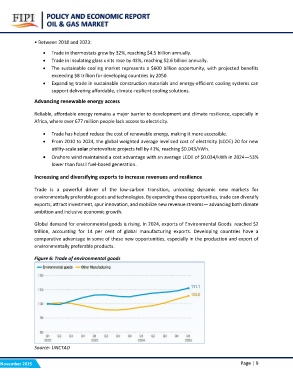
Global demand for environmental goods is rising. In 2024, exports of Environmental Goods reached $2
trillion, accounting for 14 per cent of global manufacturing exports. Developing countries have a
comparative advantage in some of these new opportunities, especially in the production and export of
environmentally preferable products.

Figure 6: Trade of environmental goods

                   Source- UNCTAD  Page | 9

November 2025

