


Page 25 - Policy Economic Report- June'26
P. 25
POLICY AND ECONOMIC REPORT
               OIL & GAS MARKET

           from 697 to 957 items, incorporating emerging sectors and improving representation of manufacturing,
           services, and clean energy. Alongside the revised WPI, the Government introduced three PPI indices—
           Output Producer Price Index (Output PPI), Trial Input Producer Price Index (Input PPI), and Service
           Producer Price Indices—bringing India's producer price statistics closer to international best practices
           followed by advanced and emerging economies.

           Unlike the CPI, which measures price changes experienced by consumers, the PPI capture price
           movements from the perspective of producers by measuring changes in prices received for outputs and
           prices paid for production inputs. These indices provide policymakers and businesses with a more
           comprehensive assessment of production costs, industrial competitiveness, supply-side inflation, and
           pricing pressures across goods and selected service sectors. The revised statistical framework is expected
           to strengthen inflation monitoring, improve policy formulation, and enhance the analytical assessment of
           price transmission across the economy.

           The newly introduced Output Producer Price Index (Output PPI) provides a broader measure of price
           movements from the producer's perspective and complements the Wholesale Price Index in assessing
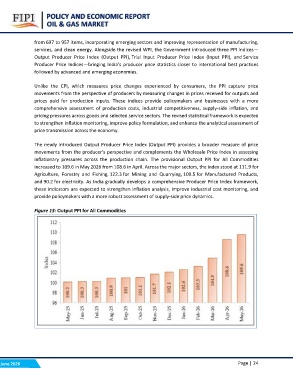
           inflationary pressures across the production chain. The provisional Output PPI for All Commodities
           increased to 109.6 in May 2026 from 108.6 in April. Across the major sectors, the index stood at 111.9 for
           Agriculture, Forestry and Fishing, 122.3 for Mining and Quarrying, 109.5 for Manufactured Products,
           and 90.2 for electricity. As India gradually develops a comprehensive Producer Price Index framework,
           these indicators are expected to strengthen inflation analysis, improve industrial cost monitoring, and
           provide policymakers with a more robust assessment of supply-side price dynamics.

           Figure 13: Output PPI for All Commodities

June 2026  Page | 24

