


Page 7 - Policy Economic Report- June'26
P. 7
POLICY AND ECONOMIC REPORT
           OIL & GAS MARKET

                           Impact of economic factors on Oil & Gas sector in India

           Domestic Production Trends

               • The continued decline in domestic crude oil and natural gas production remains one of the key
                    structural challenges facing India's oil and gas sector. According to Index of Eight Core Industries
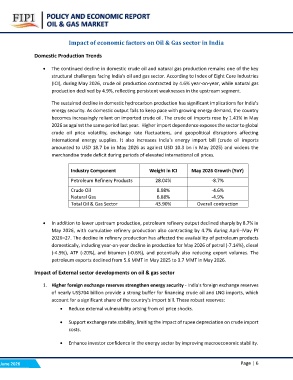
                    (ICI), during May 2026, crude oil production contracted by 4.6% year-on-year, while natural gas
                    production declined by 4.9%, reflecting persistent weaknesses in the upstream segment.

                    The sustained decline in domestic hydrocarbon production has significant implications for India's
                    energy security. As domestic output fails to keep pace with growing energy demand, the country
                    becomes increasingly reliant on imported crude oil. The crude oil imports rose by 1.41% in May
                    2026 as against the same period last year. Higher import dependence exposes the sector to global
                    crude oil price volatility, exchange rate fluctuations, and geopolitical disruptions affecting
                    international energy supplies. It also increases India's energy import bill (crude oil imports
                    amounted to USD 18.7 bn in May 2026 as against USD 10.3 bn in May 2025) and widens the
                    merchandise trade deficit during periods of elevated international oil prices.

           Industry Component           Weight in ICI  May 2026 Growth (YoY)

           Petroleum Refinery Products     28.04%                 -8.7%

           Crude Oil                        8.98%                 -4.6%
           Natural Gas                      6.88%                 -4.9%
           Total Oil & Gas Sector          43.90%         Overall contraction

               • In addition to lower upstream production, petroleum refinery output declined sharply by 8.7% in
                    May 2026, with cumulative refinery production also contracting by 4.7% during April–May FY
                    2026–27. The decline in refinery production has affected the availability of petroleum products
                    domestically, including year-on-year decline in production for May 2026 of petrol (-7.14%), diesel
                    (-4.9%), ATF (-20%), and bitumen (-0.6%), and potentially also reducing export volumes. The
                    petroleum exports declined from 5.6 MMT in May 2025 to 3.7 MMT in May 2026.

           Impact of External sector developments on oil & gas sector

               1. Higher foreign exchange reserves strengthen energy security - India's foreign exchange reserves
                    of nearly US$704 billion provide a strong buffer for financing crude oil and LNG imports, which
                    account for a significant share of the country's import bill. These robust reserves:
                         • Reduce external vulnerability arising from oil price shocks.

                         • Support exchange rate stability, limiting the impact of rupee depreciation on crude import
                              costs.

                         • Enhance investor confidence in the energy sector by improving macroeconomic stability.

June 2026                                              Page | 6

